Blog

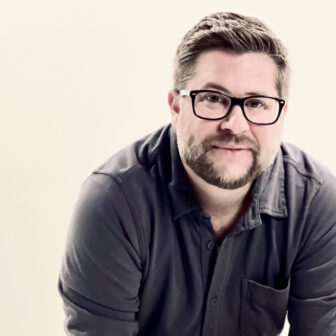
“Our BS meter is finely tuned”: A Q&A with Executive Creative Director Marshall Statt
Most creative conversations today are about AI. This one is about the humans.
Senior Content Strategist Emma Alexander sat down with DS+CO Executive Creative Director Marshall Statt to talk about instinct, intention and what gets lost when we skip the “hard part.”
Q: You’ve spent 20 years in the creative field. Did you always know this was the work you wanted to do—or did you arrive here from somewhere unexpected?
Some of my earliest memories involve drawing: at a small desk my grandparents set up for me in their den, with a stack of construction paper and Mr. Sketch scented markers. My grandma had been an art teacher and took great pride in my work. I was around 8 when I discovered the world of Marvel comics and got really into recreating my favorite comic book covers—my fav artist was Todd McFarlane.
That was the first time I remember thinking “this could be my job,” but it wasn’t until high school that I was steered toward graphic design (and RIT) by my studio art teacher.
In college, my world got a lot bigger. I went from being the only “art kid” to being surrounded by them—equally talented and intimidating. After four years in RIT’s design boot camp, I came away with sharpened skills and a sense of work ethic that would help me land an internship-turned-job at DS+CO. Looking back on the 20 years since, I’m grateful for those teachers who led the way, and now I have the opportunity to help pay it forward to my team.
Q: There’s a pull happening right now toward things that feel made—vinyl, sourdough, film cameras, hand-lettering. Do you think that’s a reaction to something? And does it mean anything for how brands should be thinking?
I’ll speak for myself here. I like working with my hands. I like building things. I like the feeling of accomplishment when someone enjoys something I made, whether that’s an office renovation for my wife, a backyard hockey rink for my boys or an illustration for a client. I spend so much time on a screen and designing for a screen that it’s nice to unplug and nerd out on something completely different.
If there’s a pull happening, it’s toward balance—finding or rediscovering things that make you happy and making time for them.
For brands, it’s important to remember that we all live varied, complicated lives. Knowing how your audience thinks, what they value and where they spend their time will help you meet them where they are. Our bullshit meter is finely tuned, and if your marketing is generalized or fabricated, it will get ignored.
Q: In a recent meeting, you talked about human senses being irreplaceable in creative work—things that engage touch, weight, texture, instinct. What do you mean by that, and what gets lost when the process skips past them?
A large majority of our marketing work is delivered through digital channels. It’s cost-effective and targeted. But it’s also one-dimensional. That excludes three important senses in smell, taste and touch, which are all closely tied to memory and emotion. Not surprisingly, we’ve seen a shift back to print and more tactile experiences like tradeshows and brand activations.
Our MCC Foundation client is the best example of this trend. For their annual gala, we’ve created over a dozen years of dimensional invitations, gala environments and thematic details that have made this a top fundraiser in the area. One year, our Willy Wonka garden invitation came printed on growable seed paper, with a magnifying glass to read a hidden message, all enclosed in an envelope that smelled like candy. Another year, we went ’80s MTV with a package that looked like a cassette tape, including a backstage pass, foldout collage and video intro from Max Headroom (look him up).
For something like an event, the experience needs to be immersive from first touch to last call, and that means considering all senses through every detail. But I believe all brands should be considering ways to engage their customers at a sensory level—from the email outreach to the packaging to the onsite experience. It’s all part of your brand experience.
Q: There’s enormous pressure right now to move fast—more content, more channels, faster turnaround. You’ve built creative teams for a long time. What does craft actually require of a person or a team, and is there a real tension with the pace everyone’s working at?
The idea of “craft” is a very human thing. It’s not about perfection or speed—it’s about doing the thing with purpose and meaning, and using techniques that were passed down, along with stories.
I deeply believe there’s a big segment of our culture that values (maybe more than ever) things that are well made and have lasting impact—and they’re willing to wait. For me, craft isn’t a yes-or-no concept. It’s a spectrum of options. I like shifting the conversation from “speed vs quality” to one about value. For every decision made to speed up production or shortcut a process, there is something lost—whether that’s breadth or depth of thinking, quality control or the chance to test a theory.
And while AI is getting us to a better solution faster, craft is most noticeable in the execution of the idea. That’s where a craftsperson makes their mark. Using their expertise, taste and instincts to make something memorable. Those are the products that you proudly share with friends and family—because you’re now part of that story.
Q: In a world where a lot of the work can be produced quickly and cheaply, what’s the argument for doing it the hard way? What justifies the time and the effort?
I wouldn’t say it’s always the “hard way,” but there is a way that feels more honest—which for some things matters. We’re in the people business, and people are strange and flawed. Our trust is earned through emotion, not logic. And when almost anything in the world can be ordered to your doorstep, there’s psychology to waiting.
It’s the reason I got into vinyl a few years ago and the reason my wife just planted a vegetable garden. We made the conscious choice to do something that takes more time and effort because it makes us feel more connected to things we already love.
That connection is important—and it’s a superpower in the branding world. To be clear, we will always need quick and cheap, but it occupies such a smaller amount of brain space than the things we really value. Why wouldn’t we spend our time and effort there, too?
Q: If a young designer or copywriter is just starting out and reads this, what’s the one thing you’d want them to hold onto as the work gets faster and the tools get easier?
Experience the world and take risks. A few years back, the opportunity to travel to Bali fell in my lap. I was to be paired with a Balinese film crew I’d never met to shoot a documentary—not on the resort-lined coast, but deep in the countryside in a family’s home. I was terrified and felt way out of my depth.
A conversation with my wife made the difference. “It’s a once-in-a-lifetime trip,” she said. “You have to go—the kids and I will be fine.” That plus some words of encouragement set me off to the other side of the world.
It was an amazing experience, not just because Bali is beautiful, the people were incredibly kind and the shoot went well, but because I learned a few things about myself. 1. I’m braver than I give myself credit for. 2. My teachers, mentors and experiences up until that point had prepared me for whatever was going to happen.
Your instincts and confidence will serve you well through whatever is coming next. Lean into hard work and surround yourself with people you can learn from and who build you up. You have what it takes.
Check out a few more of our Q&As with members of our leadership team: