Blog

Through the looking glass: The branding problem hiding inside AI visibility
There’s a version of your brand you have never approved.
It has no messaging guide, legal review or final-final-v5 deck with comments resolved.
And yet, it exists.
Ask an AI tool to recommend a company like yours or compare you with a competitor, and it’ll assemble an answer before the person asking ever lands on your website.
That answer can become the first version of your brand they meet.
I’ve been thinking about this lately because most content strategies I’ve built or researched start with the same foundational question: What should the brand say?
This still matters—a lot. But AI now throws in another question: What can the available evidence prove?
There’s often a wider gap between those two answers than anyone realizes.
The brand in the mirror
More than a century ago, sociologist Charles Horton Cooley introduced the “looking-glass self”: the idea that we partly form our identities through how we imagine others see us.
He was writing about people, not brands. But the metaphor travels.
Think of your brand’s website as a self-portrait of your organization. The messaging and content represent your intended identity, carefully curated and typically approved by several people before anyone sees it.
AI search looks beyond that portrait.
Depending on the AI search tool and the question, it may retrieve your website alongside coverage, reviews, directories, partner pages and other public descriptions.
It assembles an answer from what it can find and reconcile.
That answer is not necessarily your brand as you intended it. It’s the reflection: an interpretation built from the evidence available at that moment.
Here is where the mirror gets strange
There is not one reflection.
Ask the same question in three AI tools and you’ll get three versions of your position in the market. Change the prompt and you’ll get a fourth.
Google says its AI search features may conduct multiple related searches across subtopics and data sources. It also says AI Overviews and AI Mode may use different models and techniques, so their answers and supporting links can vary.
One prompt is not an AI visibility audit, it’s just a snapshot. Results can shift by platform, phrasing and even when the test is run.
So what do we do? Test.
Ask questions like:
- Who are the leading companies in your category?
- What is the best option for your specific buyer or problem?
- Why should a buyer put your brand on the shortlist?
Test several variations across more than one platform, then look for patterns.
Does your brand appear? Is it placed in the right category? Is the description current? Which competitors keep showing up—and why?
The pattern matters more than any single answer.
When the reflection tells the old story
It’s easy to assume the worst outcome is invisibility.
Sometimes it is.
But distortion can be more dangerous.
Imagine a manufacturer that has spent three years repositioning from a component supplier to an integrated systems partner.
Its website tells the new story. But its strongest coverage is dated, directories still use the old category and its case studies focus on deliverables rather than the larger business problems it solves.
Ask an AI tool to recommend integrated systems partners, and the company may be absent—or presented as the supplier it has worked hard to stop being.
The system doesn’t need to invent a false story.
It can build an outdated one from accurate but incomplete pieces.
That’s the uncomfortable part.
A company can change internally long before the information around it changes externally. When the old story is easier to find, more frequently repeated or better supported, the old story can win.
The problem is coherence, not content volume
When we have a conversation about AI visibility, it’s easy to jump into tactics. Publish more FAQs, add schema, write comparison pages, get more backlinks, pitch more pubs.
This can certainly help, but it’s not the strategy.
Google has said there is no special AI-only markup required to appear in its AI search features. The familiar foundations still matter: useful content, accessible pages, readable text, internal links, technical health and structured data that accurately reflects what appears on the page.
So don’t let anyone tell you SEO is dead. I read that 10 years ago and here we are, still kickin’.
The goal isn’t to create more content for LLMs to consume. It’s to create greater coherence between what the brand claims and what the wider information ecosystem can support.
Our goal isn’t to teach the internet to repeat your brand’s slogan, but rather to make your brand easier to understand and harder to misunderstand.
I think that requires four connected layers.
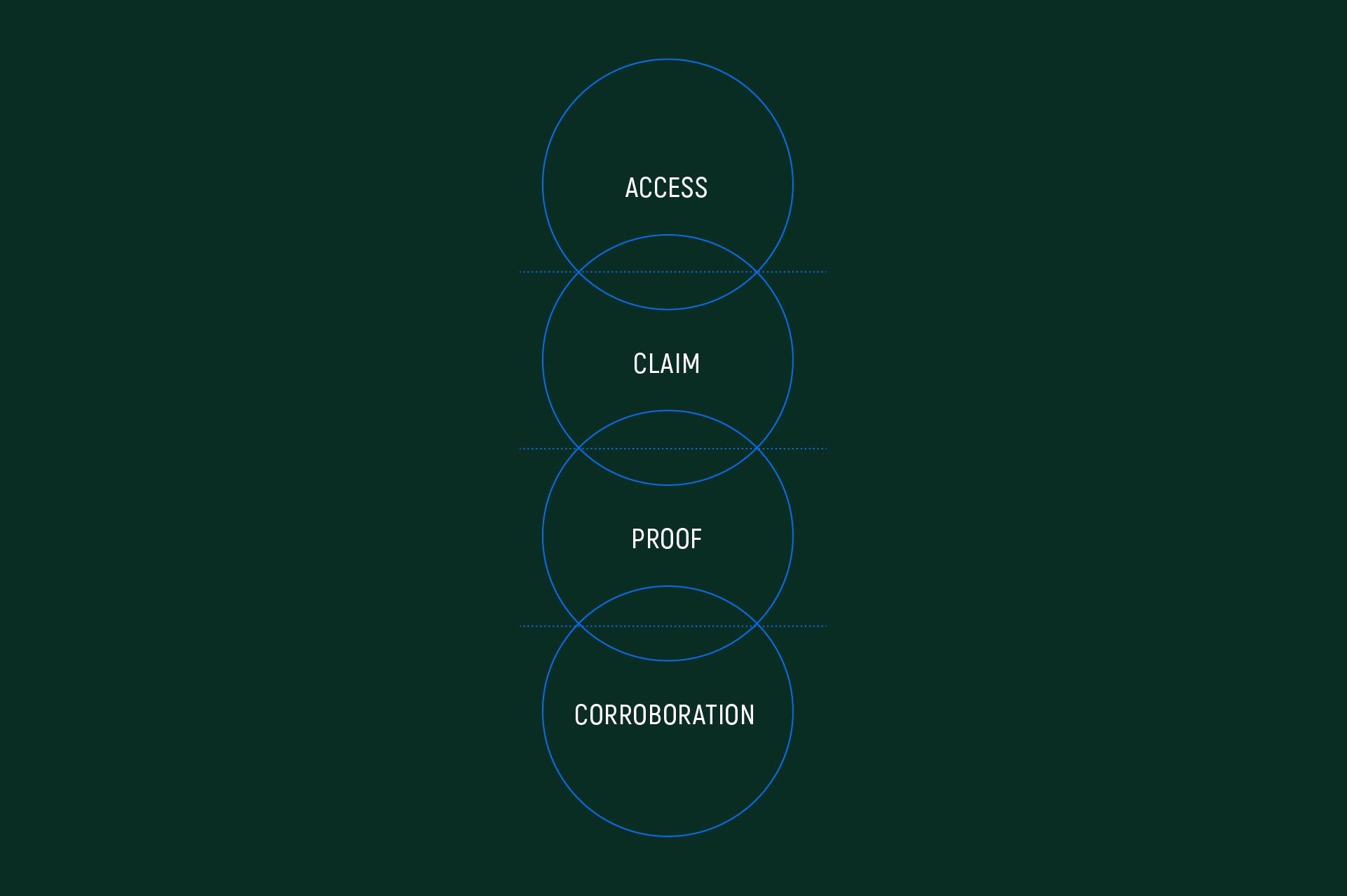
The Four Layers of AI Visibility
1. Access: Can the information be reached?
Before an answer engine can use your information, it has to find and interpret it.
Crawlability, indexing, internal links, readable text and accurate structured data still matter. Even strong positioning can’t shape an answer if the supporting evidence is difficult to reach.
2. Claim: Who are you and what are you saying?
What category do you occupy? Who are you for? What problems do you solve?
Most brands think they answer these questions, but those answers often aren’t specific enough for buyers or AI tools to understand what makes them different.
Positioning is everything.
Stake your claim.
3. Proof: Why should anyone believe you?
Think case studies. Customer outcomes. Original research. Product specifications. Transparent comparisons. Named experts with real experience.
This is where a lot of thought leadership falls apart.
It has a point of view but little evidence. Or it has useful evidence and buries it under language so abstract that nobody can extract a meaningful fact from it.
If you were to ask me what marketing hill I’d die on, this is it.
4. Corroboration: Who else confirms it?
Your website can call the brand trusted, innovative or category-leading.
It cannot independently verify those claims.
Credible media coverage, analysts, customers, partners, reviewers and experts provide context the brand can’t create by talking about itself.
Citation patterns vary widely by platform, prompt, industry and study design. Some research finds that AI search draws heavily from earned and third-party sources, while other analyses find that brand websites and managed listings play a larger role. The consistent takeaway is that no single source type carries the full story.
Third-party content does not automatically outweigh your own. But your website is still only one source in a much larger information ecosystem.
Owned content establishes your position.
Corroboration shows that position exists outside your brand’s own imagination.
Align access, claim, proof and corroboration, and your intended story becomes easier to retrieve, interpret and repeat accurately.
This is not one team’s job
Once you map the evidence, the gaps tell you what to do next:
- An access gap = a web or SEO priority.
- A claim gap = a positioning problem.
- A proof gap = a research, case-study or subject-matter-expert assignment.
- A corroboration gap = a PR, customer-advocacy, partnership or reputation brief.
AI visibility does not belong entirely to content, PR, SEO or technology. It requires them to work from the same intended position.
The reflection is not the relationship
One more important note: AI visibility isn’t simply the new version of ranking on page one.
A brand can be mentioned without being cited. It can be cited without being recommended. It can be recommended without earning a click. And it can earn a click without earning trust.
Our objective is not merely citation—we also want your brand to have access to consideration.
If the reflection promises deep expertise but the website, case studies or sales experience can’t prove it, trust disappears.
Tend the reflection without tending the brand and you’ve built smoke and mirrors.
The question worth sitting with
Every brand already has a reflection.
It lives in search results, coverage, customer language, reviews, old descriptions, current proof and all the places where those things disagree.
AI is not creating it from nothing. It’s retrieving and rearranging the available evidence.
The goal is not to control every answer. It’s to reduce the distance between the position your brand intends to occupy and the position its evidence can honestly support.
If an AI were asked not only to name a brand like yours, but to explain why it belongs on the shortlist, what evidence would it have?